Premium Artificial Grass Installation in Flower Mound, undefined

Considered Design and Precise Execution for Flower Mound, Argyle, and Surrounding Acreage Properties

Premium Artificial Grass Installation

Installation at the Level Your Property Demands

Artificial Grass of Flower Mound was established on a premise that the synthetic turf industry in North Texas has largely avoided: that estate-scale and equestrian properties in the Flower Mound, Argyle, Bartonville, and Copper Canyon corridor deserve installation work that reflects the caliber of the homes and landscapes they complement. Our principal trained in grounds management at country-club facilities in the Carolinas — environments where large-scale turf performance on irregular terrain was the baseline expectation. When he established this practice in Flower Mound, he brought that standard with him and built a team that includes a former horse-property landscaper with a decade of Denton County field experience. The result is an installation practice that is meaningfully different from what a mass-market synthetic turf contractor offers. We do not visit a property for the first time on the day of installation. We do not recommend a product without understanding the subsoil conditions, the canopy coverage, the drainage patterns, and the HOA requirements that apply to the property. We do not begin work until a written scope document — specifying product, base preparation method, drainage infrastructure, and project timeline — has been reviewed and approved by the homeowner.

  • Site assessment before any product recommendation
  • TigerTurf and SYNLawn HD product lines specified to project requirements
  • Base preparation engineered for Denton County clay and Cross Timbers root competition
  • ARB and HOA submission documentation prepared at no additional cost
  • Equestrian applications — paddock surrounds, barn-aisle runners — within standard service scope
  • Written scope document provided before contract execution

Why This Practice Produces Different Results

The factors that determine whether a synthetic turf installation performs well over time are largely invisible after the turf is installed — and that is precisely why they require the most careful attention during the preparation phase. Artificial Grass of Flower Mound's installation practice is defined by what we do before the turf rolls out, not by the speed with which we complete the visible work.

Base Preparation Engineered for the Actual Subsoil

Denton County clay and Cross Timbers loam behave differently from the sandy soils common in Collin County, and they require correspondingly different base preparation. Our site assessment profiles the actual subsoil and specifies aggregate depth, drainage infrastructure, and compaction methods relative to what the soil will and will not do. Properties with caliche hardpan layers receive above-hardpan drainage beds. Properties with significant clay content receive deeper aggregate sections. Properties in post oak woodland receive root barrier membrane below the aggregate layer. These distinctions are not optional — they determine whether the installation performs correctly in year five as well as year one.

Products Selected Against the Property Context

TigerTurf and SYNLawn HD offer product families across a range of face weights, blade geometries, and color registers. The correct choice for a Copper Canyon estate elevation that reads against a stone terrace and a lake view is different from the correct choice for a Robson Ranch courtyard where the ARB has published specific color standards. We make those distinctions before installation rather than defaulting to a single product across all applications.

ARB and HOA Documentation That Moves Through Review

Flower Mound's master-planned communities, Argyle's Robson Ranch, Southlake's Timarron, and Copper Canyon's gated sections all maintain architectural review processes with specific submission requirements. We prepare complete submission packages — color samples, drainage specifications, product data sheets, and maintenance protocols — and manage the board process on the homeowner's behalf. Our submissions rarely require revision because we research the specific board's requirements before filing.

Equestrian Applications Specified Correctly

A paddock turnout — the high-traffic zone immediately adjacent to the gate where horses stand and wait — experiences a level of concentrated hoof pressure and abrasion that would destroy a residential lawn product within a year. We specify commercial-grade products with reinforced backing for equestrian applications, installed over twelve-inch compacted aggregate rather than the six-inch depth appropriate for residential lawn work. That distinction is fundamental, and making it correctly is part of what separates our practice from suburban turf contractors who occasionally encounter a horse property.

Proportional Design Before Installation

The margin, the blade height, the color register, and the transition treatment at hardscape edges and bed margins all affect how an installation reads from the primary viewing positions — the terrace door, the motor court, the second-floor overlook. We assess those sight lines before specifying anything, because the proportional decisions that are made before installation cannot be corrected after the turf is secured.

Our Installation Process

Every Artificial Grass of Flower Mound installation follows a protocol that begins weeks before the installation crew arrives on site. The preparation phases are where the quality of the finished work is determined, and we treat them with the attention they deserve.

1

Property Consultation and Site Assessment

Our principal or a senior team member visits the property to walk the proposed installation area, assess the subsoil conditions and drainage patterns, note the canopy coverage and root competition zones, review any HOA or ARB documentation the homeowner has available, and understand the full outdoor program — including any equestrian or agricultural elements. This visit produces a written scope document that specifies every material decision before a contract is signed.

2

HOA and ARB Coordination

Where the property is governed by an architectural review process, we manage the submission on the homeowner's behalf — gathering the applicable covenants, preparing the required documentation, and filing the submission. We do not proceed with material ordering until we have the required approval or confirmation that a formal submission is not required.

3

Site Preparation and Drainage Engineering

We remove existing vegetation, profile the subsoil, install any required root barrier membrane, and build the compacted aggregate base to the depth and drainage specification developed during the site assessment. On clay-profile properties, this phase may include perforated collection infrastructure and grade correction work that redirects drainage away from foundation approaches. The base preparation phase typically takes one to two days on residential properties and longer on acreage installations.

4

Product Installation and Seaming

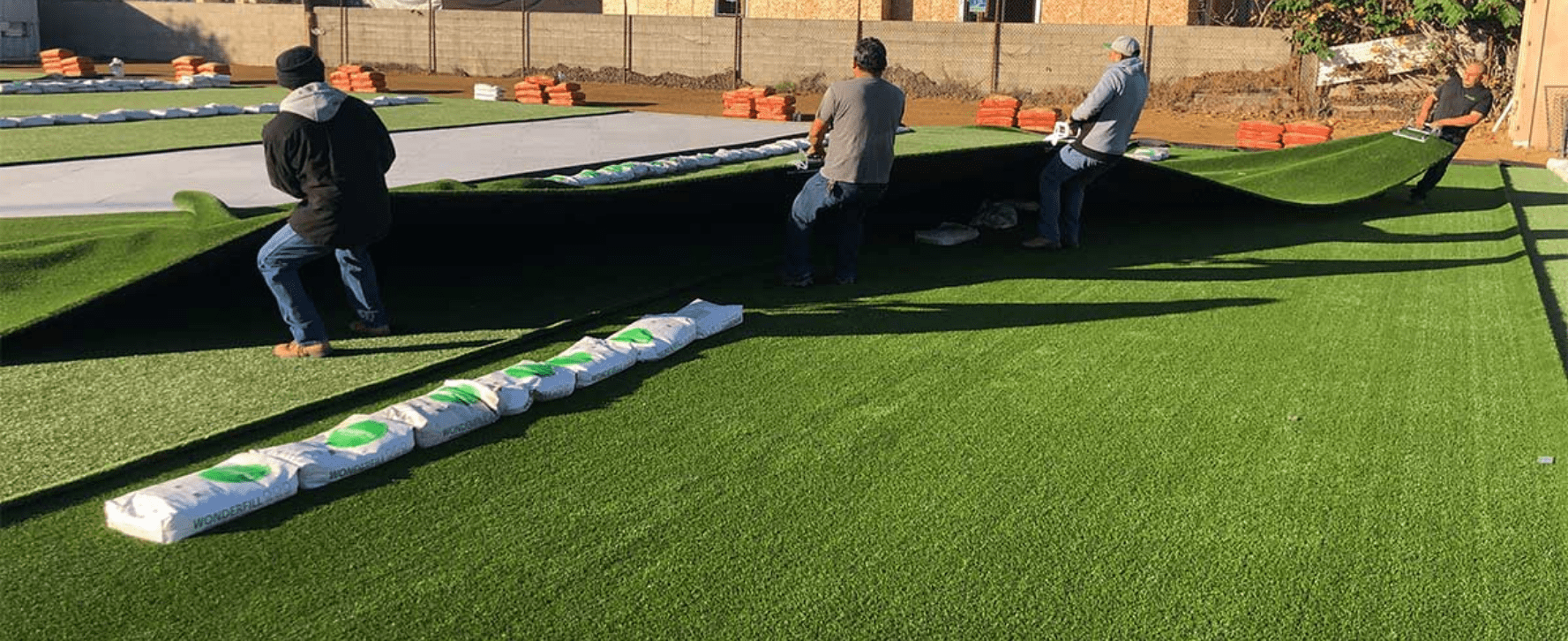
We install the specified turf product with attention to seam placement, pile direction orientation, and the proportional margins at hardscape edges and bed transitions. On properties where the installation is visible from multiple viewing angles, we confirm seam placement relative to primary sight lines before securing the perimeter. Equestrian application areas receive separate installation protocols appropriate for their specific use patterns.

5

Infill Application and Grooming

We apply infill material — silica sand, Zeolite, or hybrid blends specified relative to the intended use and pet or equestrian presence — using calibrated equipment to ensure even distribution. The infill application is followed by power-brushing to achieve the blade profile and density specified for the project.

6

Final Walk and Documentation

We conduct a thorough property walk with the homeowner, confirming drainage performance, reviewing the finished appearance from all primary viewing positions, and providing the maintenance documentation appropriate to the installed products and infill type. Where an HOA inspection is required after installation, we coordinate that process and accompany the inspector if requested.

Products We Specify for Cross Timbers and Equestrian Properties

Our product palette is drawn primarily from TigerTurf and SYNLawn HD — manufacturers whose product families provide the face weight range, backing construction options, and color register variety that estate-scale installations require. We also work with select specialty products for putting green and equestrian applications.

TigerTurf Coronado and Palisade

Our primary residential and estate-scale products. Coronado in 54-ounce face weight provides the blade density appropriate for properties with HOA color standards and significant viewing distances. Palisade in 60-ounce face weight is our specification for hail-corridor properties and large-open-lawn areas where face weight determines long-term resilience. Both products carry the UV stabilization appropriate for the North Texas sun exposure that accelerates degradation in lower-grade products.

Best For: Estate residential lawns, front elevations, large open-lawn areas, HOA-governed communities

SYNLawn HD Dual-Tone Specifications

SYNLawn's HD product line offers dual-tone color registers — blending two green tones in the same blade — that read more naturally against the existing landscape context and are better suited to ARB color-matching requirements where the installation must complement maintained natural Bermuda during its peak season. We specify these products for front elevations, lake-view terraces, and any application where the color register will be evaluated against natural grass in an adjacent context.

Best For: ARB-governed communities requiring color-matched submissions, lake-view terraces, front elevations adjacent to maintained natural grass

Commercial-Grade Equestrian Products

For paddock turnouts, round-pen perimeter footing, and barn-aisle runners, we specify commercial-grade products with reinforced primary and secondary backing designed to withstand concentrated hoof traffic and abrasion. These products are installed over twelve-inch compacted aggregate bases rather than residential-grade shallow sections. The visual appearance of these products is a secondary specification criterion — performance under the actual use pattern is primary.

Best For: Paddock turnouts, round-pen surrounds, barn-aisle approaches, gate-adjacent high-traffic equestrian zones

Putting Green Surfaces

Our putting green product specifications are drawn from a separate catalog than our landscape turf lines — these are products designed to a stimpmeter performance standard, with blade geometry and infill specifications that produce authentic ball roll and chip response. We specify these products relative to the intended performance target: tour-caliber surfaces for serious golfers, performance-recreational surfaces for household use. Neither category is appropriate for general landscape applications.

Best For: Home putting greens, chipping areas, golf practice complexes

Partial-Shade and Canopy-Context Products

Standard synthetic turf products read unnaturally bright under filtered canopy light — the blade color that looks correct in full sun appears oversaturated and obviously synthetic under post oak or cedar elm shade. We select partial-shade-appropriate blade colors and lighter green registers for installations beneath established canopy, a specification detail that significantly affects how the installation reads in context.

Best For: Post oak and cedar elm canopy zones, north-facing elevations, filtered-light outdoor rooms
Questions We Hear from Estate and Equestrian Homeowners

Our HOA has specific color standards. How do you handle that?

We research the HOA's published standards before the site consultation and select candidate products against those standards during the site visit. We prepare the full ARB submission package — color samples, product data sheets, drainage specifications, and a maintenance protocol — and manage the committee process on your behalf. Our submissions rarely require revision because we do the research before filing rather than after.

We have significant post oak canopy. Will the base preparation last?

Post oak root systems are aggressive and will penetrate standard crushed-aggregate bases within three to five years on Cross Timbers properties. Our protocol uses root barrier membrane at the soil interface below the aggregate base, which significantly extends the base's resistance to root intrusion. This adds to the base preparation cost, but it is not optional on properties with established post oak woodland — it is the specification that determines whether the installation performs in year seven the way it does in year two.

We have horses. Can you address both the residential landscape and the equestrian areas in one scope?

Yes, and we approach them as a single property program with two distinct technical contexts. The residential landscape portion is specified as an estate installation — products, base preparation, and drainage appropriate to the appearance standards and soil conditions. The equestrian portion — paddock turnouts, barn-aisle runners, round-pen surrounds — is specified with commercial-grade products and deeper aggregate bases appropriate for hoof traffic and abrasion. Both portions receive the same site assessment and design deliberateness; the specifications simply differ because the use patterns differ.

How does North Texas hail affect your product recommendations?

Face weight and backing construction are the relevant specifications for hail resistance. Products below 50 ounces face weight show visible fiber damage after significant hail events — the impact compresses and splits the fiber tips in a way that is apparent from close range. We specify TigerTurf Coronado at 54 ounces and Palisade at 60 ounces for exposed installations in Denton County's active hail corridor. The cost differential between a 38-ounce and a 54-ounce product is modest relative to the installation total; the performance difference over the product's life is not.

What is the consultation process, and is there a fee?

The site consultation is provided at no obligation. Our principal or a senior team member visits the property, walks the proposed installation area, assesses the conditions, and conducts a conversation about the project scope and your design intent. The consultation concludes with a written scope document specifying products, base preparation, drainage infrastructure, and any HOA coordination requirements. You are under no obligation to proceed, and the scope document is yours to keep regardless of your decision.

Begin with a Conversation at Your Property

Artificial Grass of Flower Mound serves homeowners across Flower Mound, Argyle, Bartonville, Copper Canyon, Highland Village, Double Oak, Lantana, and the surrounding Cross Timbers corridor. Every engagement begins with a site visit — no phone estimates, no pressure, no obligation.

Serving Nearby Cities

Flower MoundLewisvilleCoppellGrapevineKellerSouthlakeRoanokeArgyle